

Cuba Denies It’s Negotiating With U.S. on Compensation Claims

On July 28, the United States and Cuba met to discuss the certified claims against the Cuban government. Following the talks, State Department officials briefed reporters, calling the negotiations “very substantial discussions.” The Cuban Government however, walked away with quite a different idea of what had occurred. The Deputy Foreign Minister of Cuba, Abelardo Moreno, held his own news conference stating “we are not negotiation yet. …We are now engaged in informational talks.”

According to Moreno, US representatives “have stated the need to resolve the issue as quickly as possible, but … these are going to be extremely complex negotiations from all points of view … and we cannot rush things.”

Jason Poblete, attorney at PobleteTamargo, LLP who specializes in property claims, spoke to In Cuba Today on the matter. Moreno’s statements are typical of these types of discussions, but Poblete points out that the discussions “are negotiations because they’re sitting at a table and talking about the issue,” and that Moreno’s comments show Cuba’s decision to delay the process.

Poblete goes on to add that, “These statements show they are not interested in finding a solution, that there is a tactic to delay.” It is possible that the Cuban government is waiting until after the US Presidential elections to see if a better deal arises. This would also maintain the status quo in Cuba until 2018, when Castro surrenders the presidency.

In a briefing, the State Department told press that the United States is seeking compensation for the illegal seizure of American owned property amounting to $1.9 billion, $2.2 billion in outstanding judgements against Cuba and a “hundred to a couple hundred millions of dollars” in interest that the US government had in mining.

Cuba wants almost $300 billion in compensation for what they claim to be damages caused by the US trade embargo. Moreno noted, “The solution to the issue of compensations … is obviously directly linked to the blockade. I believe that all of you understand that normalization of relations between the two countries will be very difficult, if not impossible, while the blockade against Cuba remains in place.”

The State Department said that these negotiations are similar to others the US has experienced in  negotiating claims with other countries and that both sides “are committed to trying to resolve this in a mutually satisfactory manner.”

Poblete points out that, “If the Cubans are interested in having the US sanctions removed, they would pay the claims, which would help the groups in Washington that are pushing for the elimination of sanctions” on Havana.

The second meeting between the two countries to discuss claims ended without agreement on a date for a follow-up meeting, as did the first meeting last year.

The entire article from In Cuba Today can be found here.
Going Dark, Going Forward – An Encryption Update

To understand the use and impact of encryption, consider the following facts:

  • Forty-four percent (44%) of financial services use encryption technology.
  • 30 million householders use online banking.
  • E-commerce produces $341.7 billion of revenue to the U.S. economy.

Because encryption is frequently used by businesses and other people in their daily lives, the tragic events of Paris and in San Bernardino shows how encryption can also be used for wrong. Unfortunately, law enforcement has not developed the technology to break an encryption code.

The report recognizes this dilemma, as do most law enforcement officials. One approach that has been suggested comes from Professor Ron Canetti, a cryptology expert from Boston University. Professor Canetti called for law enforcement, “[to] concentrate on encryption made by bad guys. Making the everyday encryption of the general public weak isn’t going to get you what you want, [not] when it comes to coordinated terrorist attacks. There’s no silver bullet answers.”

The majority staff agreed with Professor Canetti’s perspective that there are no easy answers. The committee recommends and supports the call for a Digital Security Commission to address this dilemma. The Commission will include individuals from the various sectors that are impacted by encryption, including, but not limited to: law enforcement, e-commerce, tech, intelligence, data privacy, and civil liberties. The Commission’s focus will be to address the encryption issue and “develop policy and legislative recommendations to present to Congress.”

The committee recognizes that the encryption debate is a very complex matter and that it will take time to reach a consensus. Kudos to them for realizing this and hopefully, the committee members would heed their advice.

As former House speaker, Newt Gingrich (R-GA) and former House Intelligence Committee Jane Harman (D-CA) wrote, “The question of encryption is too central to this country’s future to answer without a real dialogue.”

Have US Property Claims in Cuba Been Forgotten in Normalization Rush?

As diplomatic relations between the United States and Cuba are restored many families with US Certified Claims against the government of Cuba are becoming more and more concerned that their claims will remain unsettled. A recent article in The Miami Herald discusses these concerns as many American ventures in Cuba involve stolen property.

The shipping port La Maritima Parreño in Santiago, Cuba, was once owned by the Garcia-Bengochea family until it was confiscated by the Cuban government in 1960. Since then, the Garcai-Bengochea family has watched as numerous international corporations have conducted business on their property, including Carnival Cruise Line, the China Harbour Engineering Co. and Fred Olsen Cruise Lines.

Former chairman of the Foreign Claims Settlement Commission, and attorney at PobleteTamargo, discussed this growing concern in the article. “They are really running out of time to do this,” Tamargo said. “I understand some gestures of opening the process to begin discussions, but we’ve tone well beyond what we should be doing.”

Over half a century has passed since the Castro regime confiscated property from Americans and Cubans alike. The Foreign Claims Settlement Commission has certified 5,913 of the claims by Americans valued at around $8 billion. US law dictates the US government must negotiate a settlement for the claims with the Cuban government but has yet to show any progress on settling the claims.

“I am quite distressed at the level of commerce that is occurring between the two countries,” Tamargo said. “Stop giving these trade concessions; start forcing them to make an offer and settle these claims.”

Though some remain optimistic that claims will be settled, many worry that the changes to trade and travel restrictions with Cuba has depleted US leverage.

In June, Representatives Jeff Duncan (R-SC) and Albio Sires (D-NJ) requested an update on the progress of this issue from the State Department. As of July 8, they have not received a response.

“This was important at one time,” Duncan said of the claims. “The fact it has yet to be addressed is one of the most egregious items that’s out there in regards to normalizing with Cuba.”

“They’re getting everything they want, and we’re not getting anything in return.”

The full article in The Miami Herald can be found here.

St. Petersburg Family Seeks Payback for Seized Land

The heirs to one of Cuba’s largest textile companies, expropriated by the Castro regime during the Communist takeover, is seeking payback for what was stolen from their family. Textilera Ariguanabo was operated by Burke Osborne Hedges who was forced to flee Cuba in 1959, leaving behind the family textile business in addition to more than 20 other properties. According to The Tamba Bay Times, the properties are valued at $50 million.

Before the expropriation of Textilera Ariguanabo, the company was known for the free health care and high wages provided by the Hedges family. Articles in Fortune and Reader’s Digest in the 1940’s praised the Cuban business as one of the largest on the island before Batista became president, getting noticed for how well it treated its employees.

Though the family had not filed a claim before the deadline through the US Foreign Claims Settlement Commission (“FCSC”), according to attorney Jason Poblete, that should not matter.

Through 1972, the FCSC accepted claims for property nationalized by the Cuban government, and then from 2005-2006 the commission reconvened to consider additional properties that had been nationalized after 1967. According to Poblete, that set precedent that the claims program can be reopened once again.

“It will signal to foreign investors and governments around that world, that the U.S. will stand by its taxpayers, as long as it takes, anywhere foreign governments take property without compensation,” he said in the Tampa Bay Times article.

The full article in the Tampa Bay Times can be found here.

FAA Issues Final Rule on Unmanned Aircraft Systems

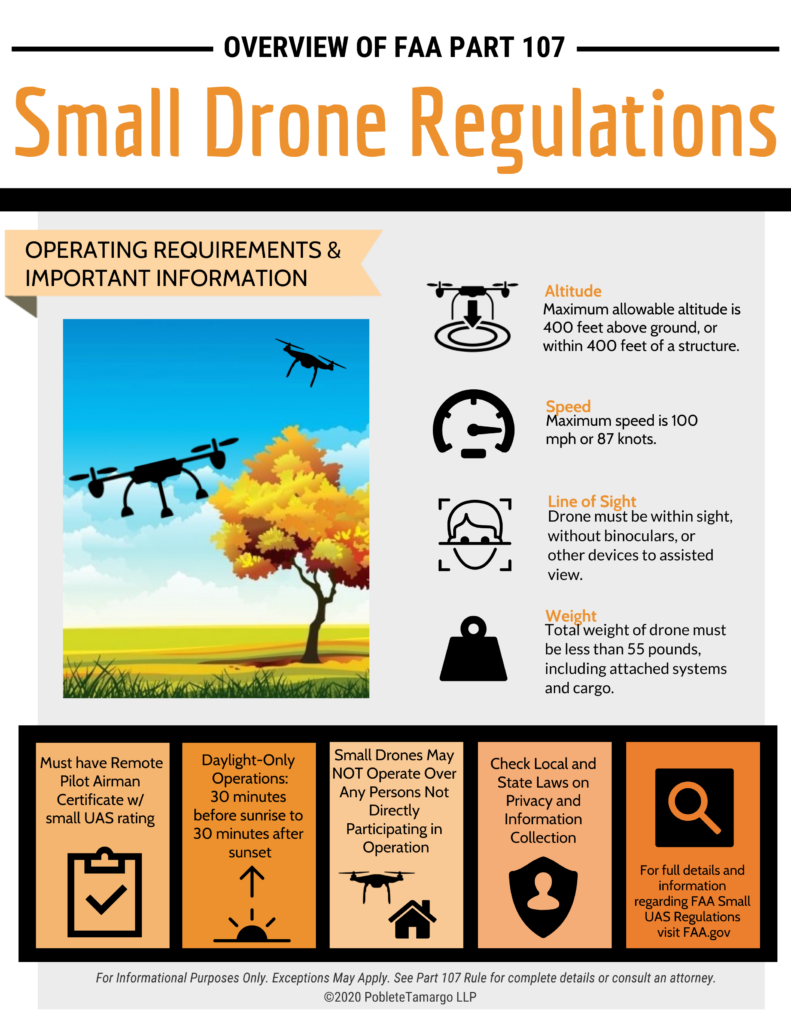
The latest announcement, Part 107 of the Federal Aviation Regulations, allows business to fly drones as long as they meet the described operational requirements. Among the regulations promulgated by the FAA:

  • Drones must weigh less than 55 pounds, including securely attached systems and/or cargo.
  • Unmanned Aircrafts must remain within unaided sight, meaning a person must be able to physically see their aircraft without the assistance of binoculars or any other device.
  • Flights must occur during daylight hours at no more than 400 feet above ground level, or remain within 400 feet of a structure.
  • Flights cannot exceed 100mph (87 knots) and must remain within state boundaries.
  • It is also prohibited to fly a small UAS “over any persons not directly participating in the operation.”
  • The FAA airworthiness certificate is no longer required so long as the pilot checks the aircraft pre-flight to ensure it is operating correctly.

The biggest changes to the regulations is the requirement of commercial drone operators to take a written drone-specific knowledge test, must be at least 16 years old, and must know English.

Though privacy concerns were not specifically addressed at this point, it was noted that future guidelines will be issued and that a government campaign educating businesses and commercial drone operators on privacy issues is taking place. The FAA does however recommend that drone operators check with state and local laws regarding privacy and data collection.

The White House noting the unaddressed privacy concerns in a general Fact Sheet on aviation technology stated:

“Looking forward, in consultation with industry and research partners, the FAA is considering additional rules that will further enable safe unmanned aircraft operations—including, for example, to govern the flight of unmanned aircraft over people. This rule is the first step towards a long-term vision of the airspace of the future that will be fully integrated, allowing for the routine safe operation of unmanned aircraft alongside manned aircraft.”

Many large companies interested in expanding on delivery services are not satisfied with the latest set of rules. According to the Wall Street Journal, many manufacturers and trade associations find the FAA regulations too narrow in scope and hinder growth by industries looking to expand exponentially in the near future. However, many of the corporate concerns were addressed by the Obama Administration’s release, which points to further research on areas such as integration of technology for public data collection and expansion of economic opportunities.

The FAA says that industry estimates are predicting that commercial drone operations will generate billions of dollars in the United States alone, with millions joining the commercial drone market, and thousands of jobs created. Companies looking to advance drone delivery services will have to wait for more extensive safety research for the time being as the government races to keep up with the latest technology.

Smaller companies have commented that the regulations cover basic requirements needed for services in various sectors such as agriculture, maintenance and safety projects. US Transportation Secretary Anthony Foxx voiced similar satisfaction in a press release on the latest rule stating, “We are part of a new era in aviation, and the potential for unmanned aircraft will make it safer and easier to do certain jobs, gather information, and deploy disaster relief.”

The drone debate will inevitably continue as new questions and concerns arise and technology expands. Commercial interests and the advancement of current technology must be conducted safely, with civilian interests and privacy concerns given equal attention. Secretary Foxx noted that the administration “look[s] forward to working with the aviation community to support innovation, while maintaining our standards as the safest and most complex airspace in the world.”

The FAA has taken a great leap towards integrating unmanned aircrafts safely into the national airspace, but this is just the first step with many still to come.


More information on Part 107 – Small Unmanned Aircraft Regulations can be found at the following websites:

*The regulations and prohibitions listed under the latest FAA rules also include the ability to apply for a certificate of waiver. If the FAA finds that proposed operations can be performed safely, they may allow for small UAS operations to deviate from specific rules. 

More information on Waivers to Small UAS Operating Rules can be found here.